Mashhad – Kabul – Samarkand
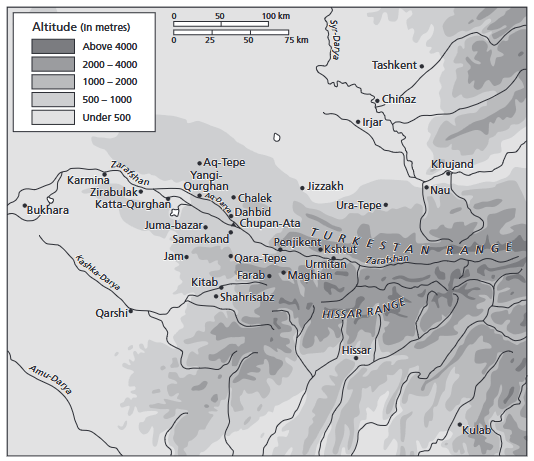
Pinchas Kabuli was born 1826 in Mashhad, Iran. From there he moved to Kabul, which he left in 1850 for Bukhara. According to a memoir, the family did not like the climate there (as well as some other things) and therefore moved to Samarkand. Before they reached Samarkand, the travellers were raided in a town called Karmina, where Pinchas Kabuli was killed on August 14, 1861.
One of Pinchas’ sons, Shlomo Bobojon Pinchasov, published several books in Jerusalem. Besides interpretations of the Torah and piyyutim, he also published a Hebrew dictionary, in which he translated Hebrew (Lishon HaKodesh, the holy language) to Persian, Russian, Aramaic, Spanish, Arabic and Turkish in the book titled “Six Languages”.
Source: National Library of Israel.


Document from the National Archive of Uzbekistan, Tashkent, about the Zaurov family, related to the Pinchasovs through marriage. The document is one of many attesting to the endeavors of Jewish families to prove that they were native (tuzemnje) to the land, recently conquered by the Tsarist army. This would allow them privileges related to trade and ownership of land. Courtesy of Ruben Pinchasov.
Excerpt from Boris Pinchasov’s autobiography
(translated from Russian)
“When I returned to Samarkand, I found the city totally changed – almost without government. workers and soldiers did to the people what they wanted, without asking the central government. They confiscated houses, goods, money from the banks. They forced people to leave their houses and many rich people were banned from the city to the outskirts and left to chance. Many, who could afford it, moved to Bukhara. From there you could flee through secret ways to Afghanistan or through the Persian border to Europe. One of the first refugees was my uncle Suleiman. In 1921 he managed to get via Kabul-Delhi by steamboat to London.
(…) After about a year in Persia we got an opportunity that we could not deny. A merchant, with whom I had worked, offered us to smuggle us in a trading caravan, that moved through the Persian border to India. The route was risky, but it was our best chance to get on. The journey to India took several weeks and was very arduous. We had to pass dangerous mountain passes and deal with sickness, cold, and constant threat by bandits. But we managed to get to Delhi safe. There we found refuge in a small community of Russian emigrants, who helped us to settle down and to plan our further actions.”
 Persian Jews